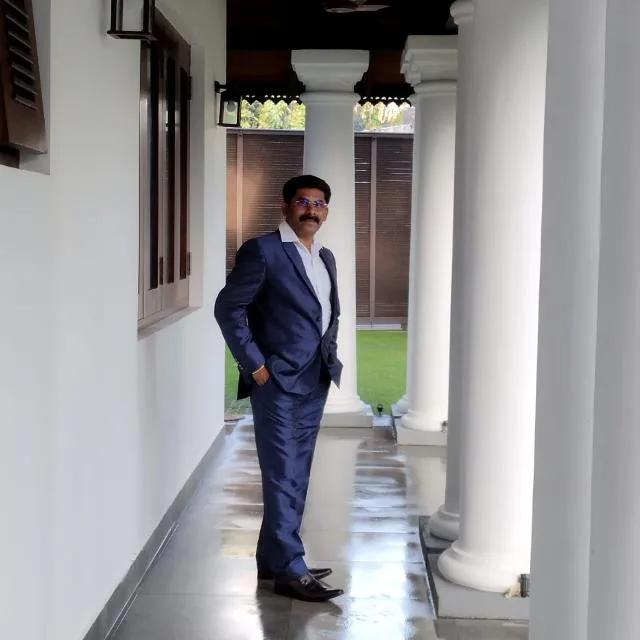
THE ENGINEER WHO NEVER SET OUT TO FARM
Saravana Kumaran Rajendran grew up in Madurai in a household where both the table and the bookshelf were fed by the land. The meals were farm-fresh produce; the reading was Sangam literature. "My father made sure we learnt and appreciated Purananuru and Agathiyan's writings," he recalls. Somewhere along the way, he admits, it all took a backseat.
He left with an engineering degree and went to work on the technology side of agriculture finding ways and means to make sustainable technology work for farming. "Solving problems was my goal, not farming," he smiles. Those years were spent on the equipment and process side of the field: the machines, the drying, the handling the unglamorous half of agriculture that decides whether a harvest survives.
The turn came in 2007, when a friend took him and his wife Sujatha to a three-day workshop with organic farming scientist G. Nammalvar. "He awakened the farmer within me," Kumaran says. It changed his outlook on agriculture entirely from purely commercial, to using his skills and education to help farmers utilise technology for sustainable farming.
The moringa idea was Sujatha's. In markets saturated with chemically grown produce, she wanted healthy, nutritional food to reach people as food they would buy anyway not capsules. When sustained production demanded technical and engineering support, he joined her. In 2009, the family's dedicated Moringa journey began.
He can still quote the Sangam couplet his father taught him as a child "Murungai Udaiyan, verungai povaan." It is often misread as "the one who eats moringa will go empty-handed."(முருங்கை உண்டான் வெறுங்கை போவான்). The true meaning, he explains, is the opposite: the one who eats moringa will not need a walking stick towards the end of his life (முருங்கையை தினசரி உணவில் சேர்த்துக் கொள்பவர்கள் ...அவர்களுடைய வயதான காலத்திலும் ..ஊன்றுகோல் துணையின்றி அவர்களே இயல்பாக நடந்து மகிழ்ச்சியாக வாழ முடியும்). The literature the young engineer set aside became the crop he now builds his life around.
The MiracleTree® family did not set out to simply farm; they sought to solve the processing side of agriculture. Recognising early that consumers needed convenient formats, the company moved Moringa beyond capsules and powders into everyday foods like bars, teas, and multigrain mixes.
The hard part is drying. Fresh Moringa is highly perishable, and inappropriate drying adversely affects colour and quality. In 2014, the company introduced ULTCD (Ultra Low Temperature Closed Chamber Drying), followed in 2019 by CLHPD (Controlled Low Heat Process Drying). Both are now applied to other herbs and vegetables.
The farm was run as a learning ground. Four planting models were trialled 12×12 ft, 8×8 ft, 4×4 ft, and high density (3,800 plants/acre) then organised into SOPs and shared with visiting farmers. During this period, MiracleTree® observed Moringa cultivation in Tamil Nadu grow from roughly 1,800 acres in 2010 to 9,000 by 2017.
Since 2021, the work has been international. MiracleTree® transferred expertise to NADEC in Saudi Arabia (2021–2023) and became a technology partner for an integrated campus at Thumrait, Oman (2025–2026) featuring 580 acres, 1.7 million trees, and a 44-tonne/day processing facility. The company's core principle remains: develop the system, document the SOP, train the team, and transfer the technology to build local capability rather than create dependency.